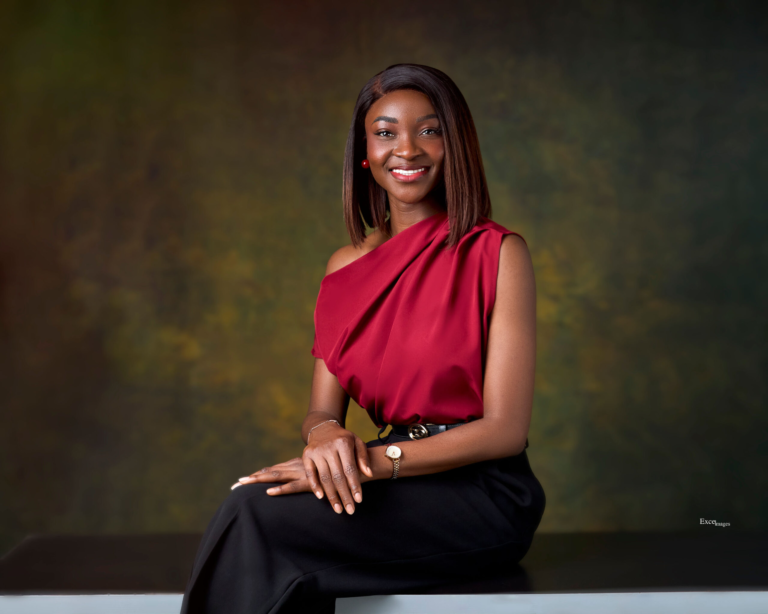

Tolu Olusina is a data and knowledge management expert within the global climate finance landscape, leveraging data to inform strategy, accountability, and impact at scale. She holds a first-class degree in Civil and Environmental Engineering from the University of Lagos and went on a fully-funded Nigerian government scholarship to pursue graduate studies at Imperial College London, where she completed a dual master’s degree in Environmental Engineering and Business Management at the global top‑ten institution in 2020. In this interview, she speaks on her work, transforming and contributing to advancing climate action and sustainable development globally.
Share with us defining moments that shaped your journey in global climate finance.
One of the most formative experiences of my life was working on the frontlines of conflict and climate crisis in North-Eastern Nigeria in 2018. In Borno State, near the Lake Chad Basin, I witnessed the brutal intersection of displacement, drought, and broken governance systems. Entire communities had lost homes, livelihoods, and security. What struck me most was not only the scale of suffering, but the systemic gaps behind it. Resources existed globally, yet they were not reaching the people who needed them most, or not reaching them fast enough. That experience ignited a deeper question in me: how does climate and development finance actually flow? Who decides? Who benefits? And how can those systems be redesigned to serve the most vulnerable?
Earning a fully funded merit scholarship to study Engineering and Business at Imperial College London expanded my sense of possibility. It placed me in rooms that were globally competitive and intellectually demanding. But perhaps more importantly, it taught me that access changes perspective. Exposure to global institutions, financial systems, and innovation ecosystems gave me language for the questions I had been carrying since Borno. Receiving my first offer from the World Bank headquarters in Washington DC after more than 30 rejections was another defining moment. It reinforced something powerful: grit is not just a personality trait, it is a strategic asset. Persistence is often the differentiator between potential and impact.
Building Career Culture HQ in the months following the loss of my father was deeply personal. Grief could have immobilised me. Instead, I channelled it into building something purposeful. Watching the platform grow to over 10,000 followers in seven months reminded me that clarity of mission can sustain you even in your lowest seasons. Being selected to work for the Green Climate Fund, the world’s largest climate fund and a UN specialised agency, affirmed that global leadership is rarely accidental. It is built step by step, often quietly, through preparation and courage.
You started your career in conflict-affected communities. How did that early grassroots experience influence the kind of global leader you have become?
Early in my career, I made a deliberate decision to leave Abuja and relocate to Borno State. It was not the obvious choice. It was, however, the right one. Sitting with families who had lost everything to conflict and drought fundamentally reshaped my understanding of development. Policy failures were no longer theoretical. Climate vulnerability was no longer an abstract concept in a report. It was a mother explaining how she could not feed her children because rainfall patterns had changed. That proximity to crisis gave me clarity. I realised that while frontline humanitarian work is critical, I wanted to operate upstream, at the level where systems are funded, structured, and reformed. What I carry from that experience into global leadership spaces is this: scale must never come at the expense of sight. When we discuss billions of dollars in climate finance, we are ultimately discussing whether real people will have water, food security, energy access, or protection from disaster. The communities most affected by climate change are not case studies. They are the reason the work matters.
Many young women in STEM still face stereotypes. What realities did you encounter as a woman in engineering and climate finance?
I graduated as the Best Graduating Student in Civil Engineering at the University of Lagos. I earned that distinction. Yet some of the responses were not congratulatory; they were dismissive. Comments questioning whether I “deserved” it or suggesting my future would be confined to domestic roles revealed how deeply entrenched stereotypes remain. Like many high-achieving women, I responded by working harder. I overcompensated. Eventually, I burned out. At Imperial College London, I was one of only two African women in a class of seventy. Representation matters, and when you are underrepresented, the psychological weight is real. There is an unspoken pressure to perform not just for yourself, but for everyone who looks like you. In global institutions, I have also experienced exclusion rooted in age, gender, and background. These experiences were not subtle. But they forced me to do the internal work: to understand my value independent of external validation. Community was transformative. Women’s networks, peer mentors, and now the young professionals I mentor through Career Culture HQ have reinforced that glass ceilings are real, but they are not immovable. Preparation, excellence, solidarity, and audacity make a powerful combination.
In your view, what are the biggest mindset shifts young African women need to make to compete globally?
It is important to acknowledge that structural barriers are real. Gender bias, limited access to capital, policy constraints, and social expectations cannot be solved by mindset alone. However, within those realities, agency still exists. The first shift is from waiting to initiating. Do not wait for perfect conditions. Build with what you have. Document your progress. Apply before you feel fully ready. The second is understanding that there is no single template for global leadership. Your path may be nonlinear. That does not make it invalid. And finally, prepare before the opportunity arrives. When doors open, they often open briefly. Read widely. Build skills continuously. Position yourself for rooms you have not yet entered.
Global leadership spaces can be intimidating. How do you maintain confidence and integrity in high-level rooms?
Imposter syndrome does not disappear with achievement. I have learned to stop expecting it to. When sitting with heads of state or senior policymakers, I remind myself that I am there because of preparation and lived experience. The journey from the Lake Chad Basin to global climate finance institutions was not accidental. Integrity, for me, means remembering why I am in the room. It means speaking when silence would be more comfortable. It means ensuring that technical decisions remain connected to human realities. Confidence is not the absence of doubt. It is the decision to contribute despite it.
What skills will define the next generation of climate and development leaders?
Adaptability will be foundational. The climate and development landscape is evolving rapidly. Communication will remain critical: the ability to translate complex technical concepts across disciplines and cultures. Strategic creativity will differentiate leaders who can design solutions for interconnected crises. Data literacy will be non-negotiable. Evidence-based decision-making requires the ability to interpret and communicate data effectively. But perhaps most importantly, resilience and ethical grounding will define sustainable leadership. The work is long-term. The pressures are high. Leaders must be anchored in purpose.
For young women who feel unseen or underrepresented in global institutions, what practical steps should they start taking today?
Visibility must be intentional. Begin by articulating your work clearly. Publish. Speak. Share insights. Build a digital footprint aligned with your ambitions. Seek community. Join professional and women-led networks. Reach out to people whose careers you admire. Most opportunities are relational. And most importantly, do not wait to be discovered. Create platforms. Apply boldly. Pitch ideas. The world often rewards visibility alongside competence.
Climate change affects women disproportionately. How can more women move from being affected to being decision-makers?
Women on the frontlines of climate change are already leading informally through resilience and innovation. Institutions must move beyond token inclusion toward genuine co-design. Women should not be consulted at the end of policy processes, but integrated from the beginning. At the same time, women aspiring to decision-making roles must build technical expertise, document impact, and cultivate strategic alliances. Climate solutions without women’s leadership are incomplete.
What kind of legacy do you hope to build in global climate and development leadership?
I want to build systems and institutions that are not only technically robust, but equitable. In climate finance, I want to contribute to an architecture where Africa is not simply a recipient, but a shaper of global financial mechanisms. Through Career Culture HQ, I envision an ecosystem that equips thousands of young Africans to access global opportunity confidently and strategically. Ultimately, I hope my legacy reflects human-centred leadership. That I used every room I entered to widen access for others. That excellence and equity were not competing priorities in my work, but complementary ones. That is the legacy I am building.
Originally published on the Guardian Nigeria.
Read the full original article here:
https://guardian.ng/guardian-woman/tolu-olusina-women-facing-climate-change-already-lead-through-resilience-innovation/